

You Have Photos. But a Story?
Maybe you have boxes of photographs. Albums filling a shelf. Thousands—or tens of thousands—of digital images on your phone, computer or somewhere in the cloud.
And every so often you look at them and think:
I’ve got to do something with all these photos.
Then you see a social media post about “creating your brand” or “telling your story.”
My story? What story? And what does that have to do with all those photos crowding me?
After 20 years of helping people turn photographs and memories into books, I’ve learned that the connection between photos, memories, stories and books isn’t automatic. For most of us, it isn’t particularly intuitive or creative either.
Sometimes we need to learn to look at what we have differently.
Don’t start with the photos
When faced with a horde of photographs, our natural instinct is to think about the photographs themselves.
I need to organize them.
I need to scan these.
I need to get these off my phone.
I should figure out which ones to keep.
All worthwhile things to do. But none answers a more interesting question:
What do I want these photographs to do?
So, for a moment, forget about organizing them. Think about your life so far.
What are you proud of?
What makes your family your family?
What has happened that you still talk about?
Who has shaped you?
What do you know that your children or grandchildren might not?
What makes you laugh every time you remember it?
What’s something you’ve done, made, learned, survived, celebrated or loved that you would like someone else to know about?
There’s a really good chance there’s a story in there.
“Tell your story” doesn’t mean “write your memoir”
I think this is where the phrase tell your story gets in our way. It can sound as though we’re all supposed to sit down and write our life histories.
We’re not.
A story worth saving and sharing can be very small.
It could be the afternoon you taught your granddaughter to make your mother’s biscuits using the stained, handwritten recipe.
The disastrous camping trip everyone still laughs about.
Your daughter’s first day of kindergarten—and her last day of high school.
The year you finally grew those tomatoes your grandfather always grew—and discovered why everyone revered them.
The five photographs that show why your dog was absolutely the best ever.
Or a favorite photograph and the story nobody knows that makes it a favorite.
Any one of those could be a story worth saving.
And here’s something else: the story doesn’t have to be mostly words.
Sometimes a sentence or paragraph gives a photograph all the context it needs. Sometimes a short introduction followed by photographs is enough. And sometimes one photograph and a few sentences tell the whole story.
Start noticing stories
Once you stop thinking that a “story” has to be a memoir—or even a book—something interesting happens. You start seeing them.
That funny photograph has a story.
So does the recipe card in your mother’s handwriting.
And the photographs of your children making the same ridiculous faces at the camera every Christmas.
One story may lead you to another.
You may realize that the story of teaching your granddaughter to make biscuits belongs with several other stories about things your mother taught you.
Five photographs of your dog might lead to stories about other pets that have been family.
A photograph from your first job might remind you of the person who took a chance on you—and the career that followed.
Now we’re getting somewhere. Not because you’ve figured out what to do with every photograph you own.
Because you’ve begun to recognize stories worth saving and sharing among them.
Then go back to the photos
Now your photographs have a different job. Instead of asking:
What am I going to do with all these pictures?
You’re asking:
Which pictures help me tell this story?
That’s a much more manageable question.
Maybe you need one photograph. Maybe you need twelve.
Maybe you discover you have photographs of the same family tradition spanning three generations.
Maybe there are photographs, letters, documents, recipes or other pieces that belong together.
And don’t worry if the photographs aren’t all wonderful.
Sometimes the slightly blurry snapshot of your mother standing in her kitchen is more important than the beautifully composed family portrait.
A photograph’s job isn’t always to be beautiful. Its job is to help someone remember.
Sometimes it’s evidence: Yes, we really did that.
And sometimes it lets someone who wasn’t there see something they otherwise never could.
And sometimes the photographs tell most of the story
Suppose you find photographs from a weekend you and your siblings still talk about.
Everyone who will see the book was there. You don’t need three pages explaining what happened. Maybe all that’s needed is a sentence or two: where we were, when it happened and why you’ve all remembered it.
Then let the photographs take over.
You remember the jokes. You can practically hear what someone was saying.
In a case like that, the photographs aren’t illustrations for the story.
The photographs are the story.
The words simply give them enough context to do their job.
When does a story become a book?
It doesn’t have to. One photograph with its story preserved is worthwhile.
So are five photographs and a paragraph.
But as you begin noticing and saving individual stories, you may also begin seeing connections among them.
The afternoons cooking with your granddaughter. The recipes you learned from your mother. The photographs of three generations around the same kitchen table.
Suddenly those aren’t unrelated photographs anymore. They’re pieces of something larger.
Or perhaps you notice ten small stories from summers at the lake. Or photographs that trace one friendship. Or moments that show a child becoming an adult.
That’s when a book can begin to reveal itself.
You didn’t start by looking at thousands of photographs and trying to invent a book.
You started with one story worth saving.
Try it
Before you organize another folder or open another box, try this. I’ll go first.
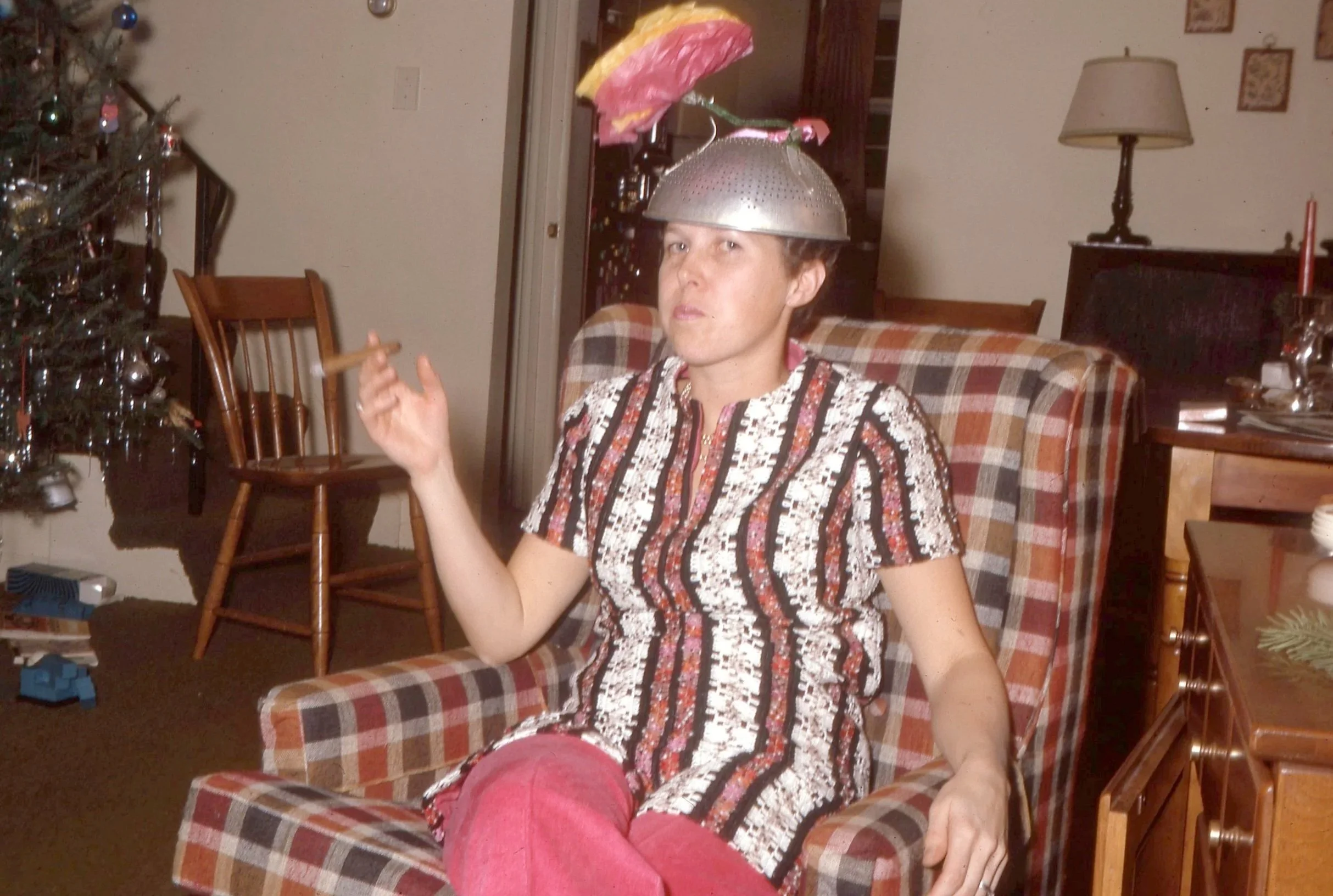
What’s going on here? Every New Year’s Eve, my parents—and my grandparents before them—threw a party where everyone was required to wear a handmade hat. This is my mother with her creation in Chicago in the 1970s. Suffice it to say, there was always lots of merrymaking!
Without the story, it’s a funny photo. With it, it’s part of our family history.
Now, your turn.
Pick one photograph. Don’t worry about whether it’s one of your “best.”
Look at it and ask:
What would someone who wasn’t there never know from looking at this photograph?
Write down the answer.
It might be two sentences. It might be a page. It might lead you to five more photographs. Don’t worry yet about what it will become.
You’ve done the important part.
You’ve saved a story.
Could those stories become your book?
That’s one of the reasons we created Pixorium BookCamp—a small-group experience designed to help you create your own photo story book.
BookCamp is not about writing your memoir or organizing every photograph you own. It is the chance to move from an idea of a story, told with photos, to a finished book.
Our next BookCamp begins in late October.
You don’t need to arrive with your whole story figured out.
In fact, you might start with just one photograph.
And one story worth saving.